Free shipping worldwide
Easy returns within 30 days
Rated ⭐4.8/5 by our clients
Free shipping worldwide
Easy returns within 30 days
Rated ⭐4.8/5 by our clients

There was no single uniform across a whole decade of bands, fans and local scenes. This guide concentrates on useful clothing choices you can repeat today. It is a wardrobe guide rather than a celebrity costume breakdown or a checklist for a particular concert.
| Piece | How to use it |
|---|---|
| Graphic or band tee | A personal focal point; let it be the only large print. |
| Straight or relaxed denim | An easy base that leaves room to move. |
| Zip hoodie or open shirt | A removable layer with a clear outline. |
| Flat skate-style sneakers | A grounded shape; use a pair that already fits well. |
| One small accent | A wristband, belt, badge or checked detail. |
Avril Lavigne’s own account of wearing hoodies, skateboarding clothes and baggy trousers is one useful early-2000s reference. It is not the whole genre. A wardrobe inspired by the period can include different silhouettes without needing to copy one performer.
A band shirt is most meaningful when it connects to music you enjoy. You can also start with an ordinary graphic tee. Clothes do not need an artist’s name on them to work with the rest of the outfit.
These music and style labels overlap, but treating them as interchangeable makes it harder to build a clear outfit. For this guide, the pop-punk starting point is a graphic tee, a practical layer and a relaxed or straight leg.
For a mid-2000s emo-inspired direction, you might choose a narrower leg, a darker palette and a more fitted band tee. Central Casting’s period guide identifies skinny jeans, band tees and studded belts among the era’s emo clothing cues. Grunge references often lean toward worn denim, loose knits and flannel instead.
These are styling tendencies, not tests of whether someone belongs to a scene. Start with the music and the shape you like, then adjust the outfit to your own fit preferences.
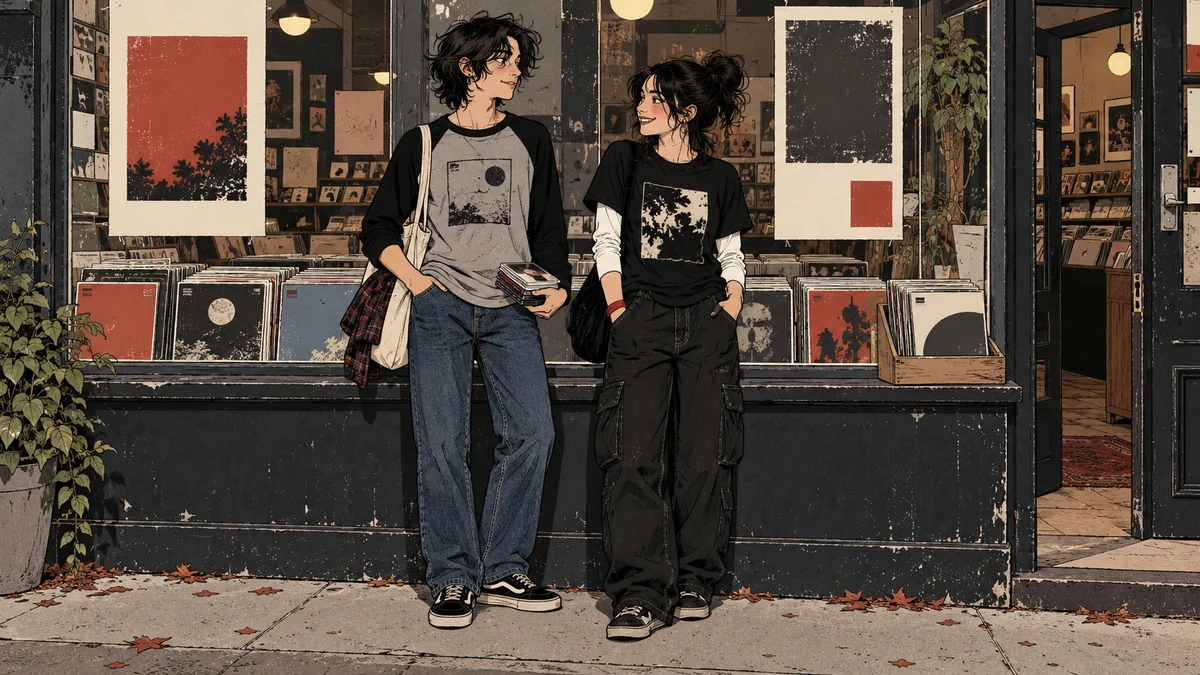
Formula: raglan long-sleeve shirt + straight dark jeans + low-top sneakers.
The sleeve contrast gives the upper half a defined shape. Keep the trousers unprinted so the shirt can carry the look. A plain canvas bag is enough to finish it.
If the shirt is oversized, try a small front tuck. You should still be able to move comfortably without losing the waistband completely.
Formula: dark graphic tee + fitted light long-sleeve base + loose black cargos + flat sneakers.
The long sleeves create a clear contrast beneath the tee. Choose a thin base so it does not bunch at the elbows or make the neckline feel crowded.
If it is hot, remove the base layer. The graphic-and-cargo combination is already an outfit.
Formula: white or black tee + open checked shirt + relaxed denim + simple shoes.
Use the check as the main print. Choose one colour from the shirt and repeat it in a small accessory if you want the pieces to feel connected.
Wearing the shirt open makes it easy to take off. Tie it around your waist only if it stays secure and does not obstruct your plans.
Formula: black tee + dark straight jeans + plain zip hoodie + clean flat sneakers.
Keep the jeans and hoodie different enough in texture that the outfit does not become one flat block. A small silver-coloured accessory or white shoe sole can add definition.
This is a useful option when you like the music references but want a quieter outfit for daily wear.
Try two tees, one long-sleeve base, one hoodie or shirt, one pair of jeans and your usual sneakers. Swap tops before you buy another pair of trousers. That reveals which cut and length you actually wear most.
Your first addition should solve a real problem: a smoother base layer, denim with a better waist fit, or a hoodie that fits over the tee. A second belt or a new graphic rarely solves a fit problem.
These photos show our actual clothing. The graphic shirt and plain dark cargos work as styling building blocks; neither is band merchandise.

A piece for this look
The Vintage Long Sleeve Shirt has a grey body, black raglan sleeves and an oval chest print. It suits the first formula with uncomplicated denim.
Wear it two ways: Wear it on its own with straight jeans, or under a plain zip hoodie with dark trousers on a cooler day.
Fit check: Compare the chest and sleeve measurements with a loose shirt that already works for you. Check the body length against your trouser rise.
View item & sizes
A piece for this look
The Black Cargo Jeans Womens have a washed dark finish and cargo pockets. The listing describes a high-rise, baggy fit, which works with a shorter top or a small front tuck.
Wear it two ways: Pair them with a graphic tee over long sleeves, then switch to a plain fitted tee and open checked shirt.
Fit check: Check waist, hip and length measurements rather than sizing up automatically. Make sure the hem works with flat shoes.
View item & sizesStart with one formula you can repeat next week. Add another piece when it gives you a useful new combination.
Reference notes: Entertainment Tonight: Avril Lavigne interview, 2024; Central Casting: Quick Guide to 2000s Fashion; FIT Fashion History Timeline: 2000–2009. Outfit formulas and styling comparisons are our interpretations.

Free shipping worldwide with no minimum purchase.

Transactions encrypted and secured by a SSL protocol.

Not satisfied with your purchase? Return your order for free within 30 days.

Our after-sales service is there for you from Monday to Saturday.
No account yet?
Create an Account


