Free shipping worldwide
Easy returns within 30 days
Rated ⭐4.8/5 by our clients
Free shipping worldwide
Easy returns within 30 days
Rated ⭐4.8/5 by our clients
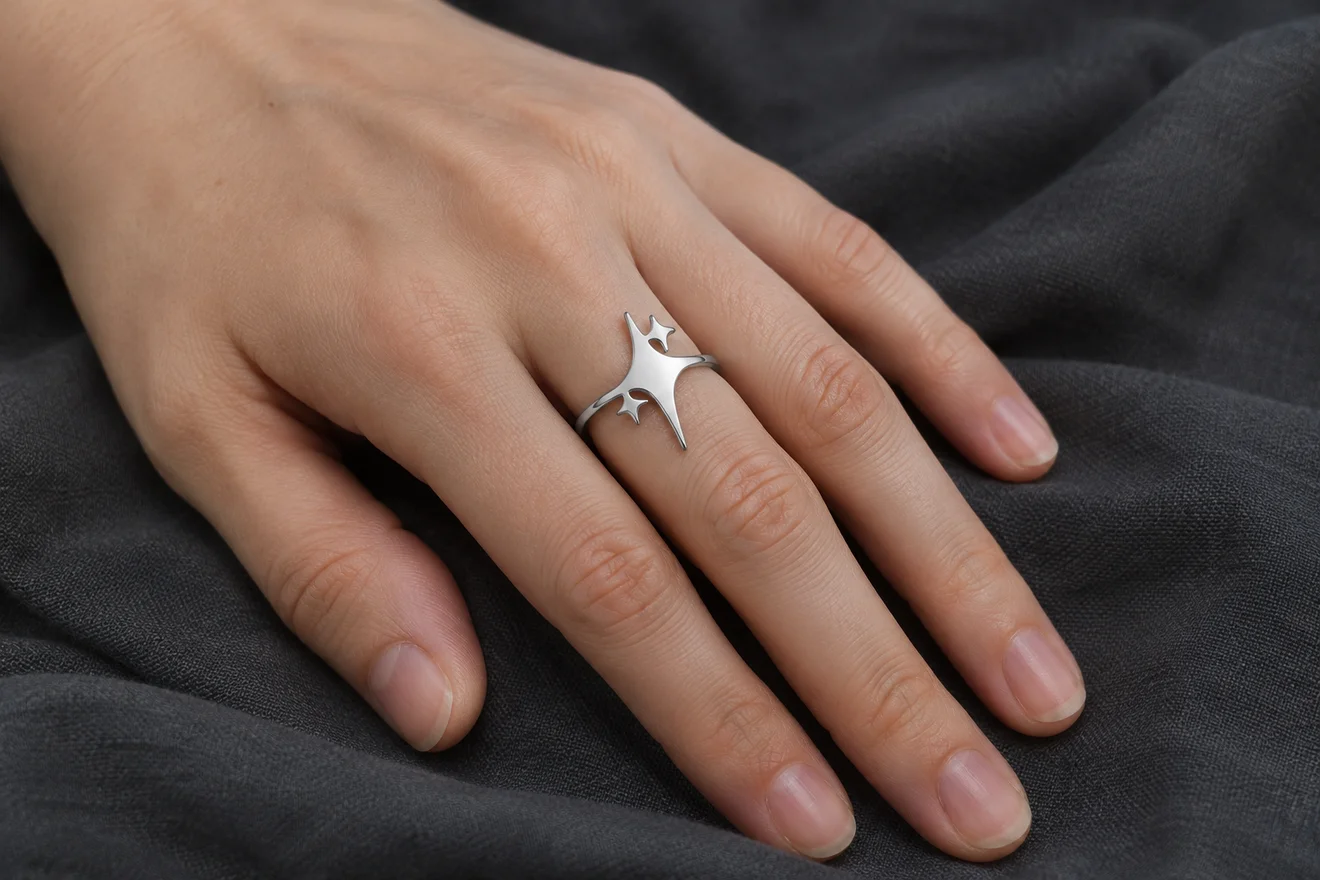
Try a narrow band with a small detail pointing along your finger, then bend your knuckle to make sure the detail leaves room for movement.
Try a thin ring first and look at the bare space above and below it. The silver version of the Sparkle Ring has a slim band and a pointed shape that can face along the length of a finger. It has a 5/5 rating across three customer reviews. Start on one finger with enough room for the pointed ends to clear your knuckle. Set your hand down and look from across a table. A narrow band leaves more of the finger visible.
If you like a wide band, use the same check with that ring alone. A broad smooth shape may feel balanced on one finger and crowd the joint on another. Try one width at a time and bend the finger all the way. If a thick band reaches the crease or feels difficult to take off, change the width or size. A style you like should also let your hand move normally.

A pointed, oval or narrow design can run along the finger. Rotate the ring gently once you have it on and compare the two directions. With the point running lengthwise, the outline leaves more room on either side. If the point sits too close to the neighboring finger or brushes the knuckle when you curl your hand, choose a smaller face or try it on a different finger.
A short wide setting can work if you want the ring to stand out without reaching toward the nail. Test it against a thin band in the mirror, then pay attention to how it feels when you pick up your phone or keys. Keep the shape you prefer when your hand is relaxed and moving. If a sharp detail catches a sleeve, use a rounder piece with that top.

Try a plain band on another finger and close your hand loosely. Keep one finger between the two pieces if their sides rub or the sparkle shape becomes hard to see. A thin band on the other hand can give you the same metal finish without using more of the space beside the main ring. Compare with one ring off so you can tell whether the second one helps.
If you want two bands on one finger, start with two narrow pieces and check how much of the finger is still free near the knuckle. Fit changes when the rings touch or stack, so try taking both off before you leave them on for the day. If they pinch or stay in a fixed lump, spread them across two fingers.

Pick up a mug or phone and bend each finger once. Look at the ring from the front and the side when you set your hand down. If the shape stays visible and the joint bends comfortably, the fit works. Move the ring, reduce its width or wear one piece if the spacing feels crowded.

Free shipping worldwide with no minimum purchase.

Transactions encrypted and secured by a SSL protocol.

Not satisfied with your purchase? Return your order for free within 30 days.

Our after-sales service is there for you from Monday to Saturday.


