Free shipping worldwide
Easy returns within 30 days
Rated ⭐4.8/5 by our clients
Free shipping worldwide
Easy returns within 30 days
Rated ⭐4.8/5 by our clients
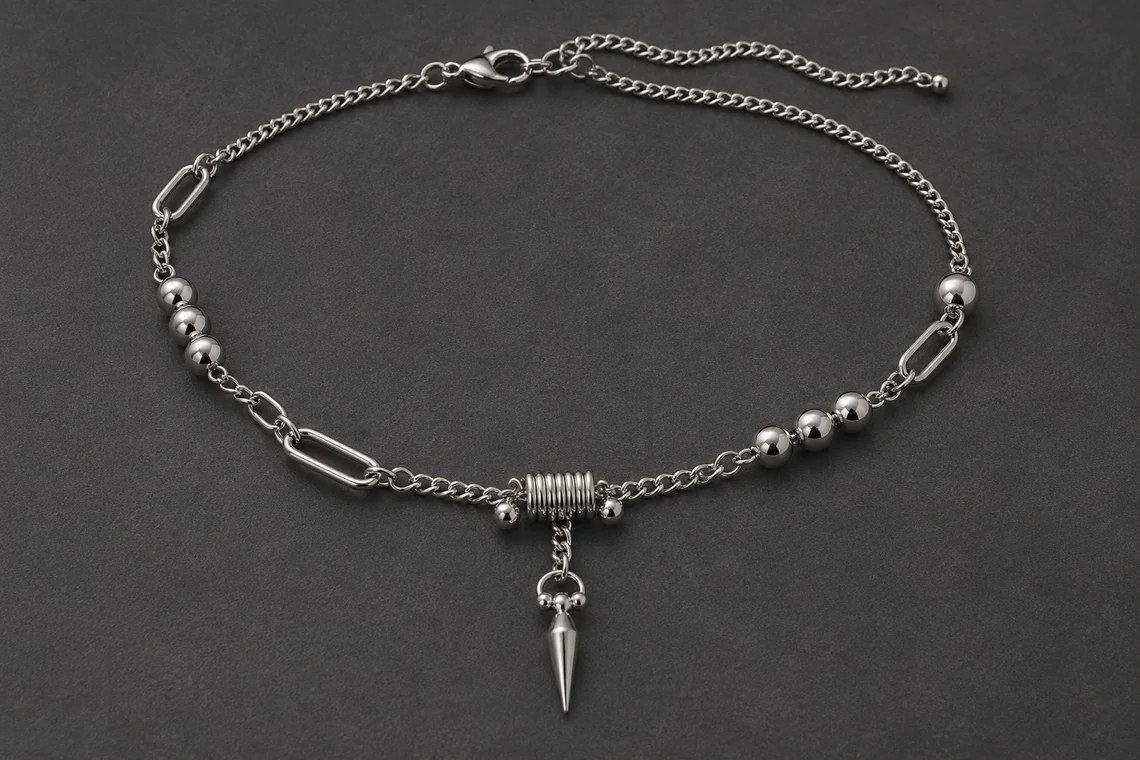
Lay the necklace flat and identify the part that moves, then open and close it once before you try to fasten it behind your neck.
The Streetwear Necklace is listed at 17.7 inches and mixes smaller links with larger decorative pieces near the front. It has a 4.67/5 average from 6 customer reviews. Look at either end of a necklace like this while it is laid out. Find the fastening hardware and separate it visually from the front links and drop. When shopping from a photo, look for a back or flat view. It is more useful for seeing the closure than a picture with the necklace already on.

If you own the necklace, open it once in front of you while looking into a mirror. See what you can hold with each hand. One side should let you work the moving part, and the other should give you a clear connector to catch. This helps explain why a fastening can look easy in a close-up photo and feel awkward once it is behind your neck.
A lobster clasp has a lever you press to open a gate. Match the open gate to its end ring, then release it and see whether it closes fully. A spring ring uses a smaller round housing and a tiny tab. Try the two types at a similar size to see which tab you can grip more easily. A toggle works differently. Put the bar through its ring at an angle, let it sit across the opening and check how it settles when the chain is on.

A box clasp usually has a piece that slides into a housing and clicks into place. Some have a separate latch. Use the maker’s instructions for a particular piece and look for the click or closure shown for that style. A clasp can be simple to use when the hands can meet in front of you and harder when you are reaching behind your neck. Try the actual motion you will need to perform.
Try the necklace with the collar or scarf you wear most. A larger clasp gives your fingers more to hold, but it may also be more noticeable beneath a high neckline. An extender gives you several usable positions if the chain was designed for it. Fasten the chain into an intended loop and leave the rest to hang naturally. See if the hanging tail is comfortable above the back of your collar.

A heavy front piece can make a closure feel different as you move. Put on the necklace, turn your head and look down as you normally do. If the hardware moves out of place, check how the chain sits around the neck. Test a compatible setting or another necklace construction if it is hard to fasten securely in your usual outfit.
Close the clasp, then gently bring the ends apart just enough to see that the connector stays in place. Check from the side that the gate, bar or latch is fully seated. Pick the type you can open and close comfortably while the chain sits at the length you want.

Free shipping worldwide with no minimum purchase.

Transactions encrypted and secured by a SSL protocol.

Not satisfied with your purchase? Return your order for free within 30 days.

Our after-sales service is there for you from Monday to Saturday.


