Free shipping worldwide
Easy returns within 30 days
Rated ⭐4.8/5 by our clients
Free shipping worldwide
Easy returns within 30 days
Rated ⭐4.8/5 by our clients
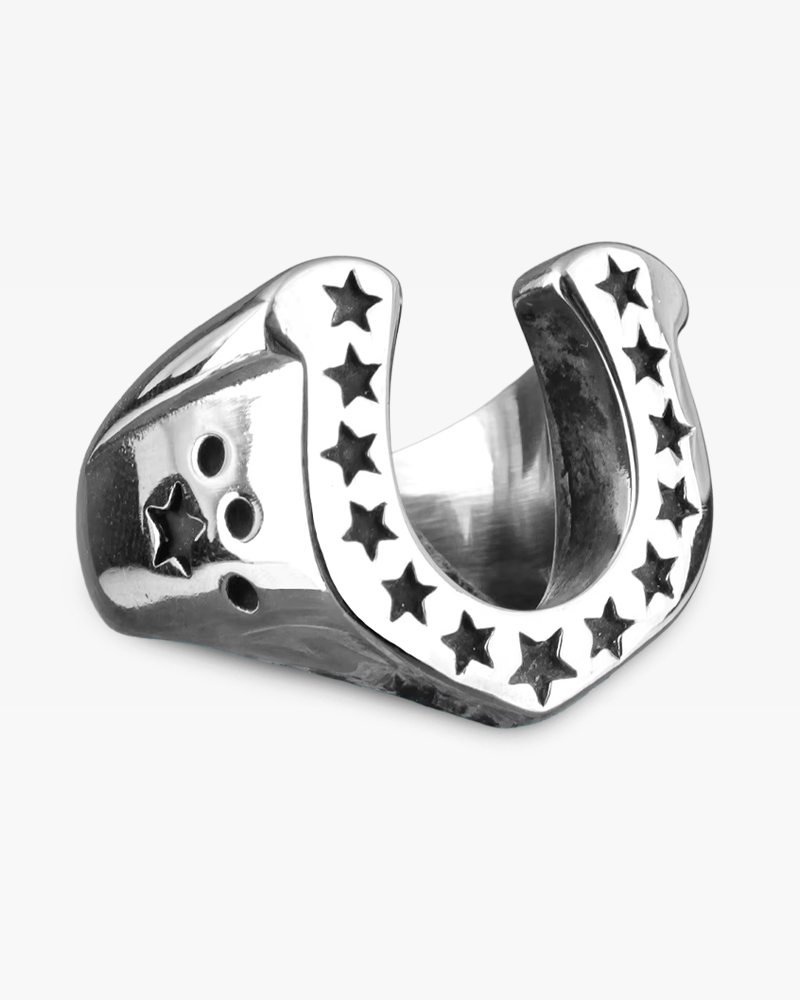
Choose a ring that goes over the knuckle with a gentle twist and sits comfortably when you make a loose fist. To shop for the same fit, measure straight across the inside of that ring at its widest point.
Our Horseshoe Ring has a horseshoe and stars design, comes in six sizes and is rated 5/5 from 10 customer reviews. A ring with a recognisable top makes rotation easy to spot, but rotation on its own tells you very little. A raised or asymmetric design can turn under its own weight even when the band fits the finger.

Choose the hand and finger before comparing sizes. Two ring fingers on the same person can need different sizes. If you own a comfortable ring for that finger, lay it on a ruler and measure straight across the inside through the centre. Keep both outer edges of the band out of the measurement. Compare the inside diameter with the seller’s chart, checking whether the numbers are in millimetres.
If the chart uses circumference instead, do not enter your diameter measurement into that column. A strip of paper wrapped around the base of your finger gives a rough circumference, but paper can compress or slip over itself. A jeweller’s ring sizer is a better choice when you fall between sizes or are ordering a ring that will be difficult to exchange.
Rest the zero mark against one inner edge. Read the opposite inner edge directly across the centre.
Suppose the outside width is 20 mm and the opening is 17 mm. On a chart labelled “inside diameter,” look for 17 mm. Including the metal would lead you to a larger size, even though the ring in your hand already fits.
Try the ring with your hand relaxed. Open your fingers, make a loose fist and hold a mug by the handle. Notice whether you are moving differently to accommodate the ring. A band you like on a flat hand may press against a neighbouring finger when you hold something. That can be a question of the ring’s shape as much as its size.
Compare a narrow band with a wider one only if you account for the difference in coverage. A broad band touches more of the finger and can feel closer than a slim band with the same stated size. Stacking two narrow rings can create a similar effect. If you plan to stack, try the pair together before deciding the lower ring is the wrong size.
With your hand over a soft surface, lower it gently and let your fingers relax. If the ring travels straight over the knuckle, choose a different size or finger. If it merely rotates but remains secure, turn the design to face slightly towards your thumb and see where it naturally settles during ordinary use.
Repeat the fitting at another part of the day before committing to an expensive purchase. A single measurement immediately after your hands have become unusually cold or warm may give you a poor idea of everyday comfort. For the final comparison, write down the finger, inside diameter and band width of a piece you like. Those details let you compare a new design much more accurately than remembering a size number from a ring you wore on another hand.

Free shipping worldwide with no minimum purchase.

Transactions encrypted and secured by a SSL protocol.

Not satisfied with your purchase? Return your order for free within 30 days.

Our after-sales service is there for you from Monday to Saturday.


