Free shipping worldwide
Easy returns within 30 days
Rated ⭐4.8/5 by our clients
Free shipping worldwide
Easy returns within 30 days
Rated ⭐4.8/5 by our clients
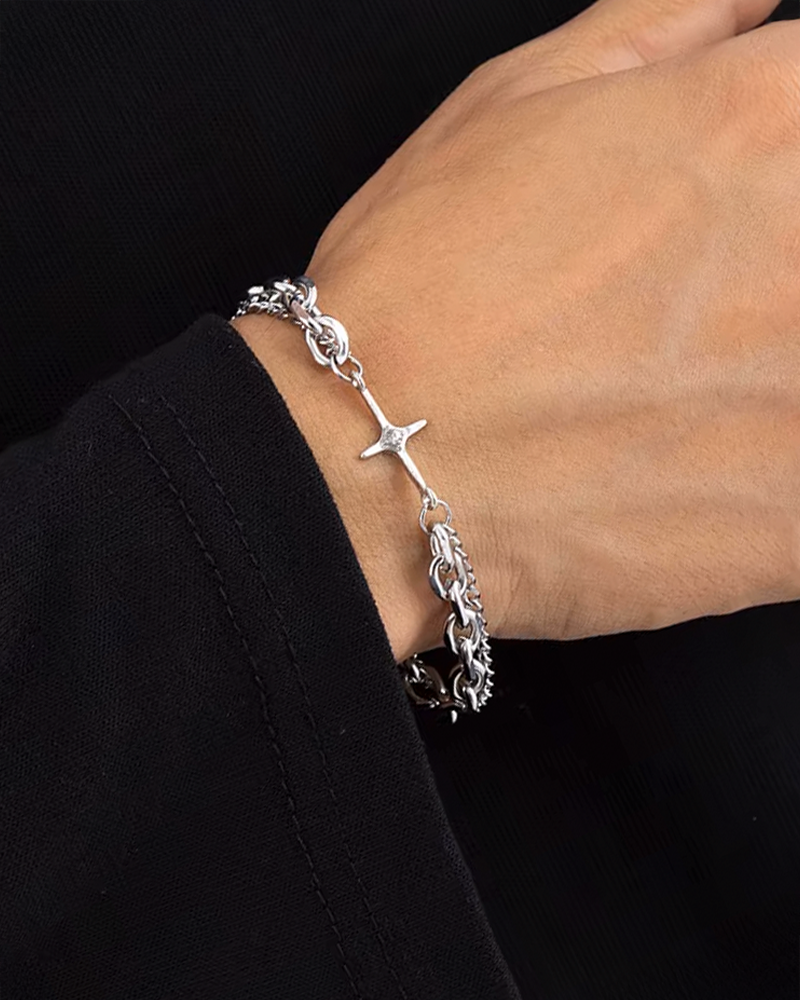
Wrap a paper strip around the spot where you wear your bracelet, mark where the ends meet, then unfold it beside a ruler. If the mark lands at 16 cm, write down “16 cm wrist.” Keep that number separate from the finished length of any bracelet you buy.
Our Y2K Bracelet Men features a cyber-style design in aluminium alloy and is rated 4.8/5 from 10 customer reviews. When considering a style like this, the number you want from the seller depends on how the bracelet opens and how much space its design occupies on the inside. A product photograph alone cannot tell you the usable circumference.

Rest your forearm on a table with the hand relaxed. Position the tape just where you want the bracelet to land. Some people like a close fit above the wrist bone, while others prefer the piece to move towards the hand. Measure both positions if you are undecided, and label the two measurements so you can remember which was which.
Without a flexible tape, cut a narrow strip of ordinary paper. Wrap it once around your wrist and mark the overlap with a pen. Remove the paper, straighten it and measure from the start to the mark with a ruler. A stretchy ribbon or elastic cord is less reliable because you can pull it tighter without noticing. Repeat the measurement once with the same relaxed hand position.
The distance between the two marks is your wrist measurement. Start at the ruler’s zero mark, even if the ruler has a blank edge.
If your wrist is 16 cm and the chart says “fits wrists 15–17 cm,” your measurement falls inside that range. If it says “bracelet length 17 cm,” you have a different number: the length of the jewellery itself. For a thick link, compare it with a similar bracelet you already enjoy wearing.
If the chart lists wrist sizes, use the number you measured and read the fit notes. If it lists finished bracelet lengths, compare against a bracelet that fits you in a similar way. A fairly flat chain sits differently from a thick curved link even if both measure the same distance laid straight. The thicker piece can leave less room around the wrist when fastened.
For a closed bangle, measuring the wrist alone misses the important question of whether the piece will pass over the hand. Compare the inside diameter with a bangle you can put on comfortably. A hinged bracelet that opens around the wrist works differently again. Check the inside dimensions and opening mechanism before assuming the external width tells you how it will fit.
Use a strip of paper to make a loose trial loop and tape the paper to itself. Try it with your hand hanging by your side and then resting over a keyboard. A bracelet you want to see below a cuff may need a different fit from one you expect to stay clear of your desk. The paper is only a guide to position; it cannot reproduce the weight of metal links.
If you plan to wear a watch too, put the watch on before choosing the bracelet wrist. Reach into a pocket and put on the jacket you usually wear. If both pieces end up jammed together under the cuff, the easiest answer may be wearing them on opposite hands. Keep your wrist measurement, preferred position and the dimensions of a bracelet you enjoy wearing together as a reference when shopping.

Free shipping worldwide with no minimum purchase.

Transactions encrypted and secured by a SSL protocol.

Not satisfied with your purchase? Return your order for free within 30 days.

Our after-sales service is there for you from Monday to Saturday.


