Free shipping worldwide
Easy returns within 30 days
Rated ⭐4.8/5 by our clients
Free shipping worldwide
Easy returns within 30 days
Rated ⭐4.8/5 by our clients
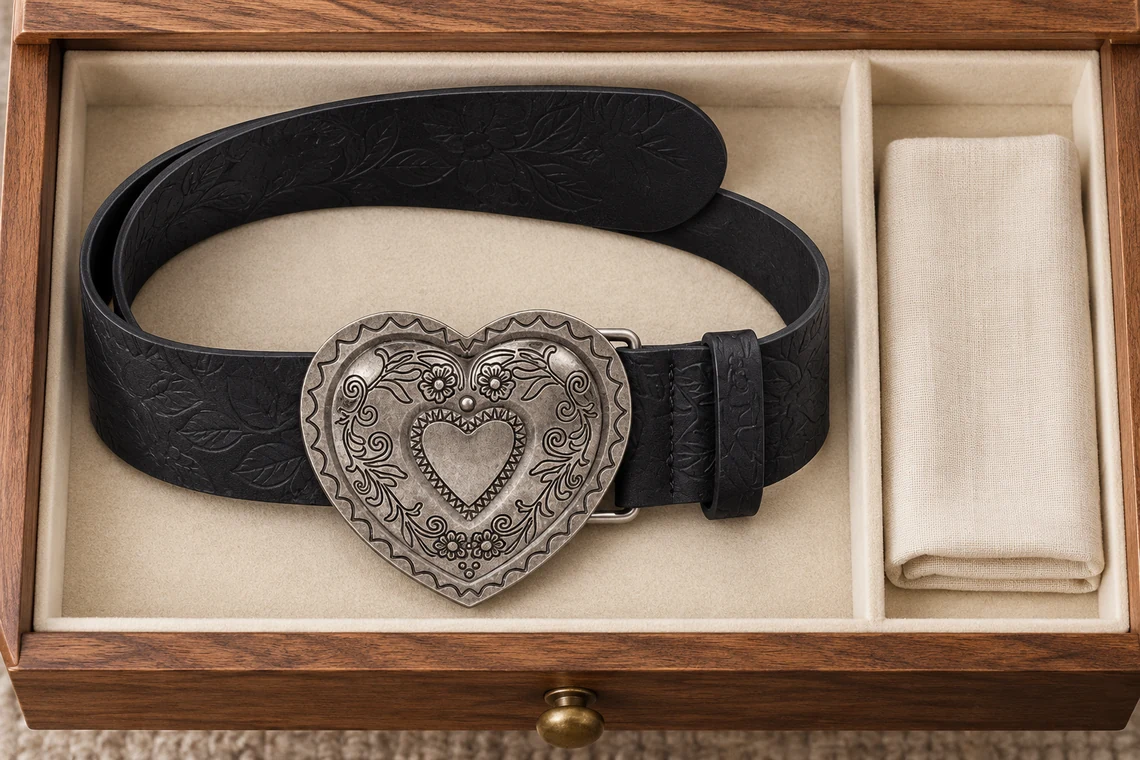
Unfasten the belt and hang it by a supported buckle or coil it loosely in a drawer so the strap keeps a gentle curve.
Lay your belts side by side and start with the heaviest hardware. The Vintage Heart Belt has a dark strap and an embossed silver-tone heart buckle that projects above it. It has a 5/5 average from 4 customer reviews. Put this kind of buckle face up in a shallow drawer or on a shelf with room around it. If it touches another belt when you close the drawer, use a divider or move the other strap instead of squeezing the roll tighter.

Run your fingers along the part of each belt that goes through the buckle. If you feel a sharp bend or see a deep line where it has been folded, give that section space to rest. Keep belts with delicate trim beside a smooth surface that will not catch on it. A drawer works best when you can see the buckle you need and lift it without taking out the other belts first.
Choose a hook wide enough to support the buckle or use a belt rack intended for that shape. Let the strap hang in a straight line. Check that the point where it meets the buckle is not twisted. Leave a little distance between hooks if metal parts touch when you take one belt out. If the strap drags on shoes or the closet floor, choose a higher hook or a shelf.

Separate the belts you use most often from special ones by how easy they are to reach. Put the everyday belts on the end of the rack or near the top of the drawer. If you routinely reach over a jeweled buckle to get at another strap, move the frequently used one forward. The right layout should also make it easy to return a belt with one movement.
Set the buckle at the end of the coil where it can lie flat or face up. Guide the strap in a wide loop and let it follow its own curve. Keep the outer end from being pushed beneath the neighboring belt. If the coil springs open, use a larger space or a soft divider. A loose ring of strap can take more room, but it is easier to lift than a tight roll wedged into a narrow opening.

Put textured, rhinestone or chain belts apart from smooth straps. A soft pouch can keep hardware from marking an adjacent surface if you need them in the same drawer. Give chains their own compartment so you can lift them without dragging a second buckle. Dry anything damp before returning it to enclosed storage and keep the drawer away from a heat source.
Open the drawer or closet and remove the first belt without moving its neighbor. Look at the strap where it leaves the buckle and check that it keeps a gradual shape. Return it to the same spot and close the drawer or door. If it catches, move the nearest divider or switch to a better-supported hook.

Free shipping worldwide with no minimum purchase.

Transactions encrypted and secured by a SSL protocol.

Not satisfied with your purchase? Return your order for free within 30 days.

Our after-sales service is there for you from Monday to Saturday.


