Free shipping worldwide
Easy returns within 30 days
Rated ⭐4.8/5 by our clients
Free shipping worldwide
Easy returns within 30 days
Rated ⭐4.8/5 by our clients
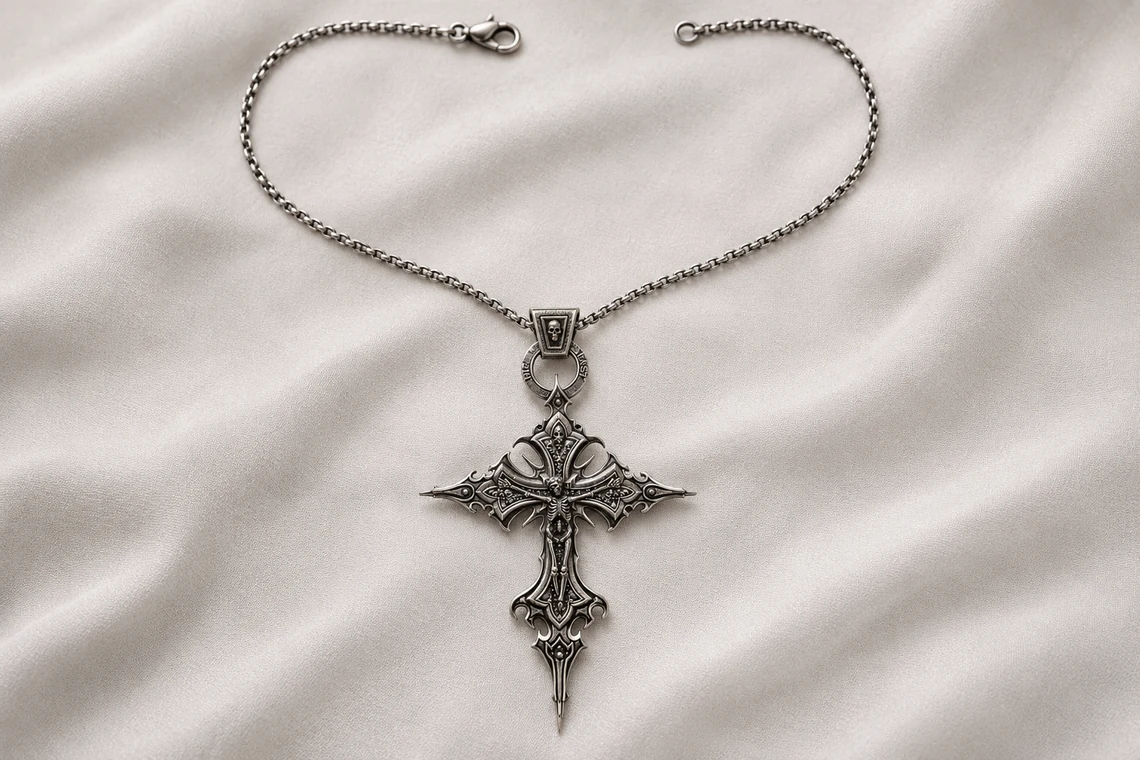
Unclasp the necklace and lay it flat on a pale cloth, then move a little slack toward the knot before trying to loosen it.
Use a flat surface with good light and a clean cloth that lets you see the chain clearly. The Gothic Cross Necklace is a 24-inch pendant necklace, so you can use its length as an example of why spreading the chain out helps. It has a 5/5 average from 3 customer reviews. Lay the cross pendant down first and let the chain come to rest around it. Keep the clasp end apart from the opposite end. Pick a spot where both ends are visible without lifting the pendant and making the chain tighten again.

Look for where the chain changes direction at the middle of the tangle. A crossing can look like a knot from above when one strand is only resting over the other. Follow each strand a little way with your eye or fingertip. If one area moves freely when you guide a little slack toward it, start there. If the chain already has a hard kink or appears damaged, stop and let a jeweler check it before you apply more pressure.
Bring the two nearest chain sections toward the knot so they have slack. Look for a loop you can widen slightly with a fingertip. Hold the chain down lightly beside it so the rest does not slide. Ease the loop wider from its inside edge. The goal is to get enough room to see the next crossing. If the loop shrinks as you move, reset the chain and bring in more slack before you continue.

A smooth blunt wooden tool can help when your fingertips cover a very small opening. Use it to separate sections gently, with the chain supported by the cloth. Let the pendant rest on the table so its weight never pulls on the knot. Skip any tool that might scratch the finish or put one link under pressure. If a fine chain still will not move after a few light attempts, a jeweler can help without guessing what the metal can take.
Once you can see the opening, trace the strand that passes through it. Move the free end back through that opening, following the same route in reverse. If the clasp is too large for the visible loop, widen it gently or try the other end. Avoid drawing a tight knot over the pendant. A second tangled necklace should stay flat beside the first until you can move one chain without dragging the other with it.

After each move, lay both sides flat and look again. One loop coming free may reveal another crossing underneath. Work on the easiest open section before you try to pull the full chain straight. This gives you a way to pause without losing track of which strand belongs where.
Lift both ends gently and see whether the chain hangs evenly. Check the clasp and look for a link that stays bent or catches as it moves. Close the necklace and store it on its own so another chain cannot slip through it.

Free shipping worldwide with no minimum purchase.

Transactions encrypted and secured by a SSL protocol.

Not satisfied with your purchase? Return your order for free within 30 days.

Our after-sales service is there for you from Monday to Saturday.


