Free shipping worldwide
Easy returns within 30 days
Rated ⭐4.8/5 by our clients
Free shipping worldwide
Easy returns within 30 days
Rated ⭐4.8/5 by our clients
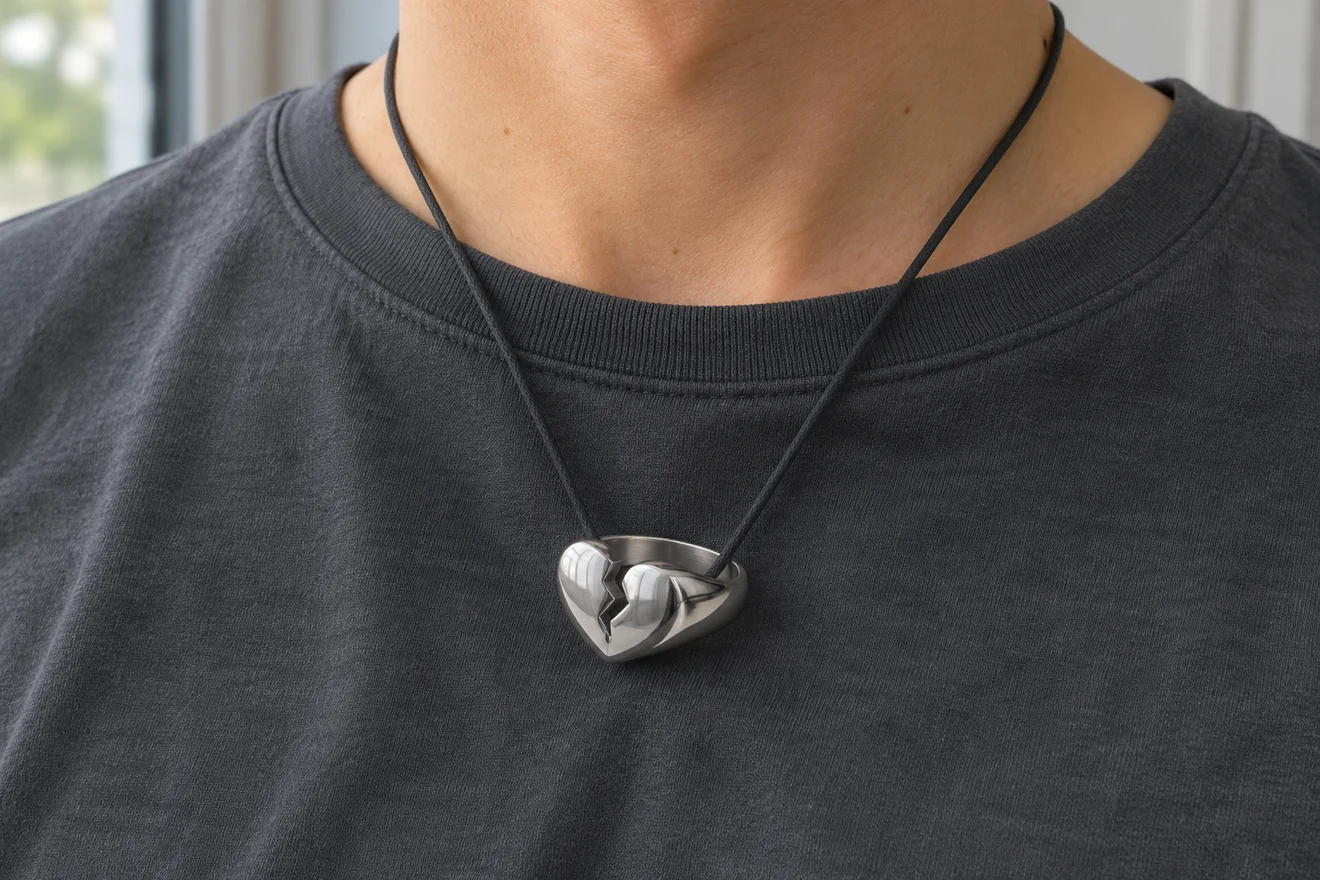
Open a simple necklace, pass its narrow end straight through the hole of a closed-band ring, and fasten it over a plain top so you can see how it hangs.
Put the necklace down on a towel or another soft flat surface. Use a ring with a fully enclosed finger opening, such as the Broken Heart Ring, which has a split-heart face on a continuous stainless steel band. It has a 5/5 rating across three customer reviews. Open the necklace and feed the smaller end through the hole where your finger goes, then bring the clasp and other end together. The ring should move freely between the ends when the necklace is open.
If the clasp or end fitting is too wide, try threading from the other end or use a cord with an end that fits. Leave the ring and necklace hardware intact. An adjustable ring with a gap needs a different solution, such as a ring-holder pendant built for that design. Use a closed band for direct threading so a thin chain cannot slip out through an opening in the band.

Put the necklace on and stand straight. The heavier face may turn down, so check both the side view and the front. A plain band can spin on a chain without changing its appearance much. A ring with a raised front may show more of the side of the band as it moves. If you want the front detail to face forward more often, try a shorter cord with a finish that gives the ring a little grip.
Check where it rests against the top. A small ring looks clear over a plain crewneck when it stays below the seam. It can also sit on bare skin inside a deeper neckline if the whole ring stays above the fabric. If the lower part rides on the edge of a top, switch to a different chain length before adding any layers.

A smooth cord can feel gentler on an everyday ring than a metal link chain that repeatedly rubs the same edge. Check the width of the chain and the condition of the clasp before you use it. For a heavier ring, choose a sturdy necklace with enough clearance through the opening. If the necklace looks or feels too delicate with the ring attached, take it off and use another one. For an important ring or one with a stone, a jeweler can show you a holder that suits its shape.
A ring pendant can sit on its own against a solid top. If you wear a second necklace, leave enough space between them that the ring does not knock into another pendant when you lean forward. Clip your bag on last. Move the strap if it crosses the necklace or repeatedly pulls the ring to the side.

Close the clasp fully, hold the ring for a moment, and let it settle against your top. Turn and lean forward once. If the ring flips onto the top edge or gets caught in a bag strap, change the drop or wear a simpler top. Take off the necklace for any activity where hanging jewelry could catch.

Free shipping worldwide with no minimum purchase.

Transactions encrypted and secured by a SSL protocol.

Not satisfied with your purchase? Return your order for free within 30 days.

Our after-sales service is there for you from Monday to Saturday.


