Free shipping worldwide
Easy returns within 30 days
Rated ⭐4.8/5 by our clients
Free shipping worldwide
Easy returns within 30 days
Rated ⭐4.8/5 by our clients
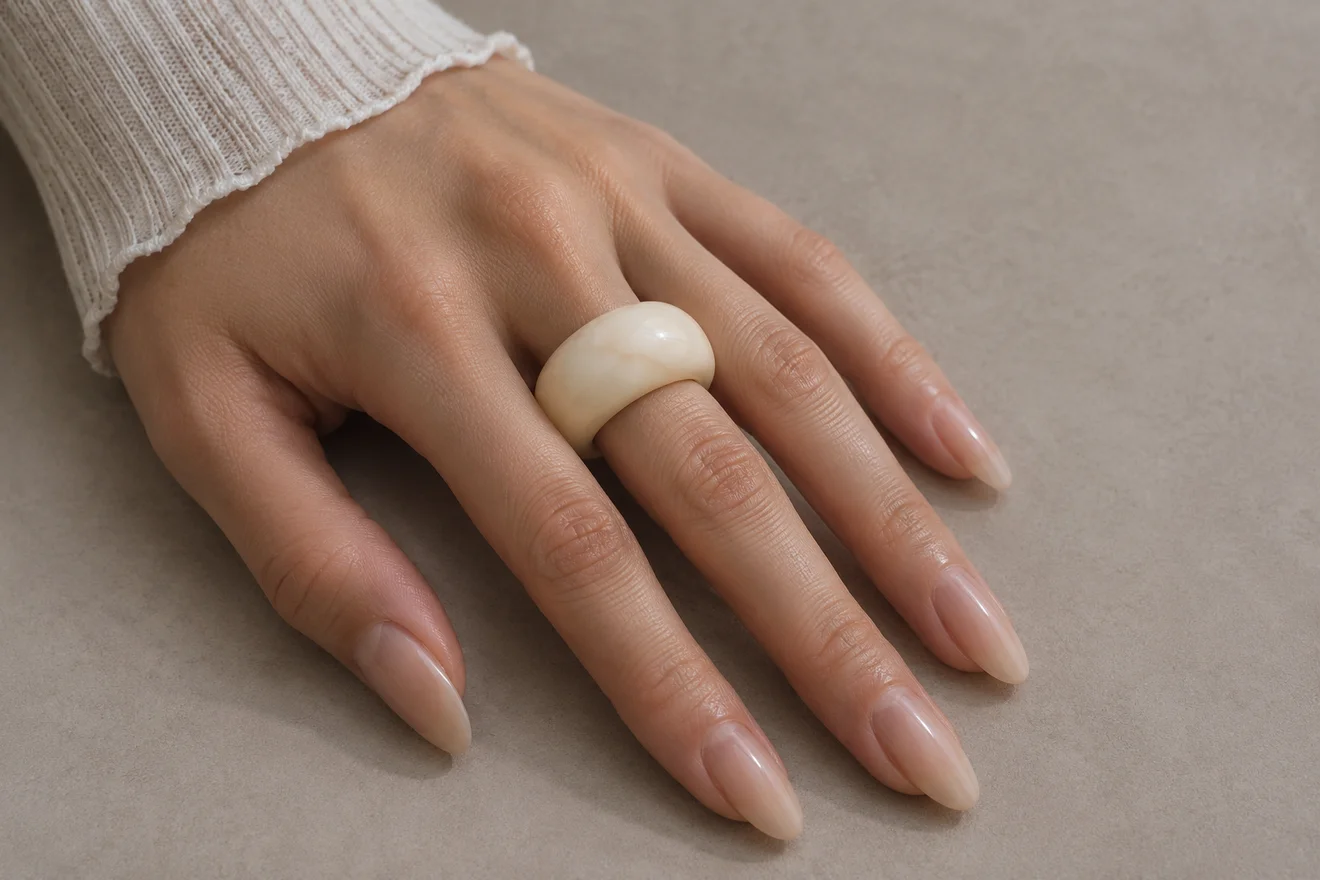
Try one rounded ring on your middle or index finger, then hold your hand at eye level to see how its width sits beside the tips of your nails.
If you have long fingers, a wider ring can create a visible point of interest along the finger. Try the ivory Domed Ring if you want a broad, smooth shape without a sharp edge near the next finger. Look at both sides of your hand. With long nails, a low curved dome can give the base of your hand some visual weight while leaving the nail tips clear. Move the ring to the index finger if it disappears between two strong nails on the middle of your hand.
See what the ring looks like with your fingers relaxed together and then spread. If the dome fills the space between two fingers, you may prefer a narrower shape or a finger with room on either side. Bend your hand around a mug or a bag handle to check the fit. A wider band can feel different from a thin ring of the same size.

Try a rounded ring beside almond or oval nails for two soft curves. Hold your hand flat and look from front to back. If the nail tips and ring look alike in color, see whether the shapes still read clearly. An ivory ring and a warm nude manicure can sit together, while the same ring with a dark manicure makes the dome stand out. You can compare the effect with a spare nail swatch or even a piece of paper in that color.
With long square nails, try a lower rounded ring or a thin flat band. The top of a square tip already makes a strong horizontal line. A dome changes the outline without adding a second corner. If you prefer an angular ring, leave more space between it and the busiest nail detail. That lets the corners show without several highlights competing in the same part of your hand.

Start with the widest ring alone. If it feels isolated after you look from a distance, add one plain narrow band on a finger farther away. An open finger between the two can separate a wide dome from a small band. With nail art, compare which finger holds the strongest nail detail. Try putting your ring on another finger to give the nail and the ring their own space.
A quiet manicure gives you room for a brighter resin color or a second slim ring. Keep the space around a taller ring clear so it can move without rubbing another band. If your fingers feel crowded only when you close your hand, remove the ring closest to the dome before changing the whole combination. Wear the arrangement for a few minutes before deciding whether it feels natural.

Pick up your phone, hold a cup and turn your palm over. The ring should stay in position without rubbing the next finger, and the manicure should still be visible from above. If the arrangement looks right and feels easy during those movements, you have a combination you can repeat with a different nail finish.

Free shipping worldwide with no minimum purchase.

Transactions encrypted and secured by a SSL protocol.

Not satisfied with your purchase? Return your order for free within 30 days.

Our after-sales service is there for you from Monday to Saturday.


